Custom SpCas9 Editor (Dual AAV)
Custom SpCas9 Editor (Dual AAV)
SKU:
Couldn't load pickup availability
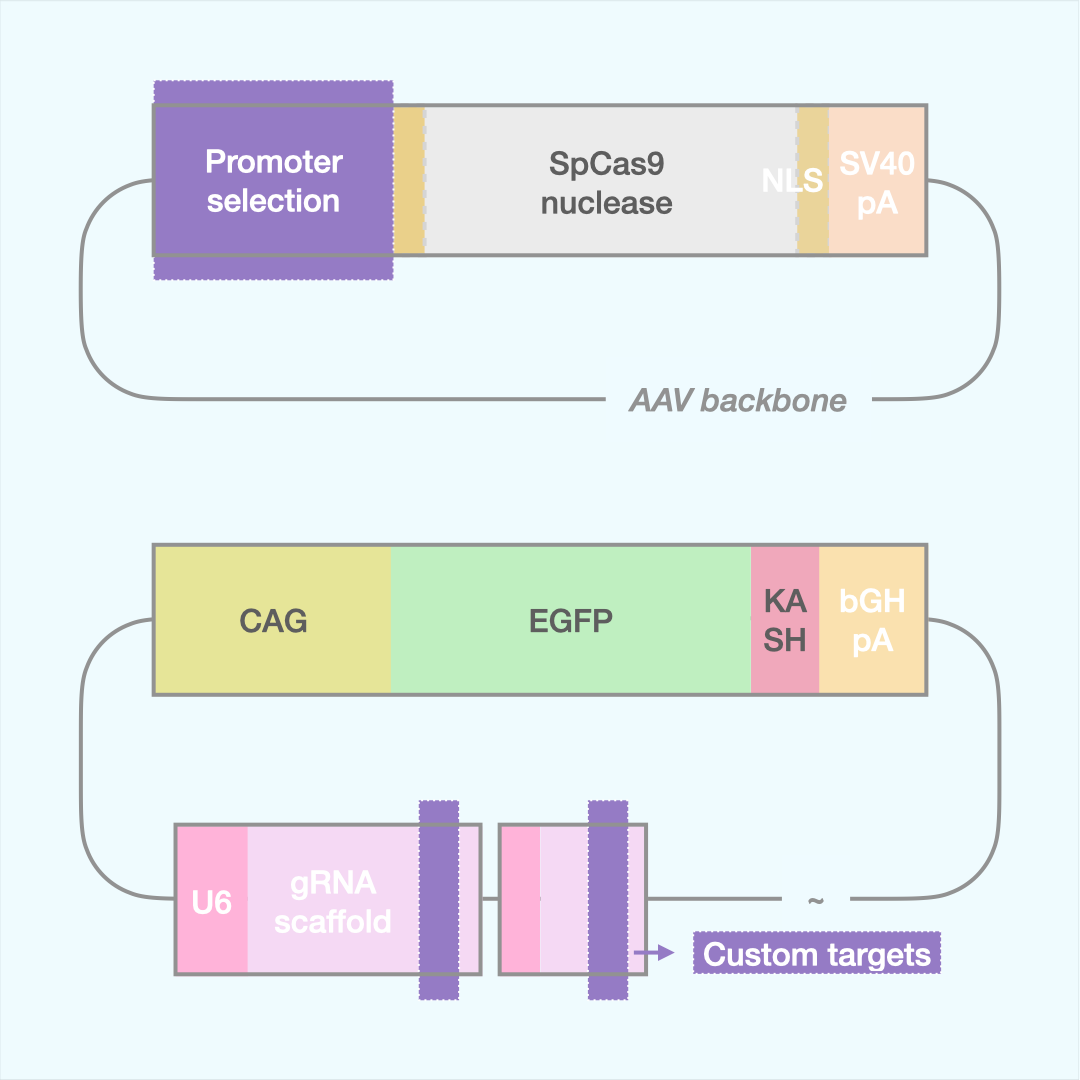
Dual-vector SpCas9 system for maximum payload flexibility. Separates nuclease and guide RNA into independent AAVs, enabling incorporation of tissue-specific promoters, multiple sgRNAs, and extended regulatory elements without size constraints. Wild-type SpCas9 (1368aa) with NGG PAM recognition delivers established performance across diverse applications. Requires co-transduction of both vectors for editing activity. Based on validated Zhang lab dual-AAV architecture (Addgene pX551/pX552)1,2.
Payload
- SpCas9 Nuclease: Most widely studied CRISPR nuclease. High efficiency across diverse cell types and organisms. Requires dual-AAV system for in vivo delivery due to size. Extensive validation data available. Multiple engineered variants exist for enhanced specificity.
- CAG Promoter: Synthetic hybrid promoter composed of the CMV immediate-early enhancer and chicken β-actin promoter, enabling strong, ubiquitous expression across most mammalian cell types. Produces very high initial expression but may undergo silencing in certain tissues over long-term in vivo studies.
- EGFP: Gold-standard green fluorescent reporter (488/507 nm) engineered from Aequorea victoria GFP, with ~35-fold greater brightness than wild-type via F64L/S65T mutations. Excitation peak perfectly matched to 488 nm laser lines on standard confocal and flow cytometry systems. The default choice for gene expression reporters, protein localization, and live-cell imaging across virtually all model organisms.
- KASH Domain: The KASH domain is the conserved C-terminal transmembrane domain from nesprin/SYNE family proteins that anchors to the outer nuclear membrane (ONM). Defined by Starr & Han (2002). Used to tether proteins to the outer nuclear membrane in engineered constructs.
- bGH PolyA Signal: Compact (225 bp) polyadenylation signal from bovine growth hormone with 3-fold higher expression than SV40 early polyA in key mammalian cell types. Size advantage over SV40 polyA makes it the preferred terminator for AAV vectors with limited cargo space. Standard terminator in commercial gene therapy and lentiviral vector platforms with decades of in vivo validation.
- SV40 Late PolyA Signal: Most widely used polyadenylation signal in mammalian expression vectors, derived from SV40 late gene region.
- U6 Promoter: RNA polymerase III promoter that drives constitutive expression of small RNAs. Provides strong, stable transcription with precise transcriptional start and termination sites.
- mCherry: Obligate monomeric red fluorescent protein (587/610 nm) with best-in-class photostability among common red reporters, enabling long-term timelapse imaging without bleaching artifacts. Fast maturation (<1 hr at 37°C) with full tolerance to N- and C-terminal fusions. Most widely used red channel partner for EGFP in two-color mammalian cell imaging.
- CAG Promoter: Synthetic hybrid promoter composed of the CMV immediate-early enhancer and chicken β-actin promoter, enabling strong, ubiquitous expression across most mammalian cell types. Produces very high initial expression but may undergo silencing in certain tissues over long-term in vivo studies.
- bGH PolyA Signal: Compact (225 bp) polyadenylation signal from bovine growth hormone with 3-fold higher expression than SV40 early polyA in key mammalian cell types. Size advantage over SV40 polyA makes it the preferred terminator for AAV vectors with limited cargo space. Standard terminator in commercial gene therapy and lentiviral vector platforms with decades of in vivo validation.
- SV40 Late PolyA Signal: Most widely used polyadenylation signal in mammalian expression vectors, derived from SV40 late gene region.
- U6 Promoter: RNA polymerase III promoter that drives constitutive expression of small RNAs. Provides strong, stable transcription with precise transcriptional start and termination sites.
- SpCas9 Nuclease: Most widely studied CRISPR nuclease. High efficiency across diverse cell types and organisms. Requires dual-AAV system for in vivo delivery due to size. Extensive validation data available. Multiple engineered variants exist for enhanced specificity.
- EGFP: Gold-standard green fluorescent reporter (488/507 nm) engineered from Aequorea victoria GFP, with ~35-fold greater brightness than wild-type via F64L/S65T mutations. Excitation peak perfectly matched to 488 nm laser lines on standard confocal and flow cytometry systems. The default choice for gene expression reporters, protein localization, and live-cell imaging across virtually all model organisms.
- KASH Domain: The KASH domain is the conserved C-terminal transmembrane domain from nesprin/SYNE family proteins that anchors to the outer nuclear membrane (ONM). Defined by Starr & Han (2002). Used to tether proteins to the outer nuclear membrane in engineered constructs.
- CAG Promoter: Synthetic hybrid promoter composed of the CMV immediate-early enhancer and chicken β-actin promoter, enabling strong, ubiquitous expression across most mammalian cell types. Produces very high initial expression but may undergo silencing in certain tissues over long-term in vivo studies.
- bGH PolyA Signal: Compact (225 bp) polyadenylation signal from bovine growth hormone with 3-fold higher expression than SV40 early polyA in key mammalian cell types. Size advantage over SV40 polyA makes it the preferred terminator for AAV vectors with limited cargo space. Standard terminator in commercial gene therapy and lentiviral vector platforms with decades of in vivo validation.
- SV40 Late PolyA Signal: Most widely used polyadenylation signal in mammalian expression vectors, derived from SV40 late gene region.
- U6 Promoter: RNA polymerase III promoter that drives constitutive expression of small RNAs. Provides strong, stable transcription with precise transcriptional start and termination sites.
- SpCas9 Nuclease: Most widely studied CRISPR nuclease. High efficiency across diverse cell types and organisms. Requires dual-AAV system for in vivo delivery due to size. Extensive validation data available. Multiple engineered variants exist for enhanced specificity.
- mCherry: Obligate monomeric red fluorescent protein (587/610 nm) with best-in-class photostability among common red reporters, enabling long-term timelapse imaging without bleaching artifacts. Fast maturation (<1 hr at 37°C) with full tolerance to N- and C-terminal fusions. Most widely used red channel partner for EGFP in two-color mammalian cell imaging.
- CAG Promoter: Synthetic hybrid promoter composed of the CMV immediate-early enhancer and chicken β-actin promoter, enabling strong, ubiquitous expression across most mammalian cell types. Produces very high initial expression but may undergo silencing in certain tissues over long-term in vivo studies.
- bGH PolyA Signal: Compact (225 bp) polyadenylation signal from bovine growth hormone with 3-fold higher expression than SV40 early polyA in key mammalian cell types. Size advantage over SV40 polyA makes it the preferred terminator for AAV vectors with limited cargo space. Standard terminator in commercial gene therapy and lentiviral vector platforms with decades of in vivo validation.
- SV40 Late PolyA Signal: Most widely used polyadenylation signal in mammalian expression vectors, derived from SV40 late gene region.
- U6 Promoter: RNA polymerase III promoter that drives constitutive expression of small RNAs. Provides strong, stable transcription with precise transcriptional start and termination sites.
- SpCas9 Nuclease: Most widely studied CRISPR nuclease. High efficiency across diverse cell types and organisms. Requires dual-AAV system for in vivo delivery due to size. Extensive validation data available. Multiple engineered variants exist for enhanced specificity.
- EGFP: Gold-standard green fluorescent reporter (488/507 nm) engineered from Aequorea victoria GFP, with ~35-fold greater brightness than wild-type via F64L/S65T mutations. Excitation peak perfectly matched to 488 nm laser lines on standard confocal and flow cytometry systems. The default choice for gene expression reporters, protein localization, and live-cell imaging across virtually all model organisms.
- KASH Domain: The KASH domain is the conserved C-terminal transmembrane domain from nesprin/SYNE family proteins that anchors to the outer nuclear membrane (ONM). Defined by Starr & Han (2002). Used to tether proteins to the outer nuclear membrane in engineered constructs.
- CAG Promoter: Synthetic hybrid promoter composed of the CMV immediate-early enhancer and chicken β-actin promoter, enabling strong, ubiquitous expression across most mammalian cell types. Produces very high initial expression but may undergo silencing in certain tissues over long-term in vivo studies.
- bGH PolyA Signal: Compact (225 bp) polyadenylation signal from bovine growth hormone with 3-fold higher expression than SV40 early polyA in key mammalian cell types. Size advantage over SV40 polyA makes it the preferred terminator for AAV vectors with limited cargo space. Standard terminator in commercial gene therapy and lentiviral vector platforms with decades of in vivo validation.
- SV40 Late PolyA Signal: Most widely used polyadenylation signal in mammalian expression vectors, derived from SV40 late gene region.
- U6 Promoter: RNA polymerase III promoter that drives constitutive expression of small RNAs. Provides strong, stable transcription with precise transcriptional start and termination sites.
- SpCas9 Nuclease: Most widely studied CRISPR nuclease. High efficiency across diverse cell types and organisms. Requires dual-AAV system for in vivo delivery due to size. Extensive validation data available. Multiple engineered variants exist for enhanced specificity.
- CAG Promoter: Synthetic hybrid promoter composed of the CMV immediate-early enhancer and chicken β-actin promoter, enabling strong, ubiquitous expression across most mammalian cell types. Produces very high initial expression but may undergo silencing in certain tissues over long-term in vivo studies.
- bGH PolyA Signal: Compact (225 bp) polyadenylation signal from bovine growth hormone with 3-fold higher expression than SV40 early polyA in key mammalian cell types. Size advantage over SV40 polyA makes it the preferred terminator for AAV vectors with limited cargo space. Standard terminator in commercial gene therapy and lentiviral vector platforms with decades of in vivo validation.
- SV40 Late PolyA Signal: Most widely used polyadenylation signal in mammalian expression vectors, derived from SV40 late gene region.
- mCherry: Obligate monomeric red fluorescent protein (587/610 nm) with best-in-class photostability among common red reporters, enabling long-term timelapse imaging without bleaching artifacts. Fast maturation (<1 hr at 37°C) with full tolerance to N- and C-terminal fusions. Most widely used red channel partner for EGFP in two-color mammalian cell imaging.
- U6 Promoter: RNA polymerase III promoter that drives constitutive expression of small RNAs. Provides strong, stable transcription with precise transcriptional start and termination sites.
- SpCas9 Nuclease: Most widely studied CRISPR nuclease. High efficiency across diverse cell types and organisms. Requires dual-AAV system for in vivo delivery due to size. Extensive validation data available. Multiple engineered variants exist for enhanced specificity.
- SV40 Late PolyA Signal: Most widely used polyadenylation signal in mammalian expression vectors, derived from SV40 late gene region.
- U6 Promoter: RNA polymerase III promoter that drives constitutive expression of small RNAs. Provides strong, stable transcription with precise transcriptional start and termination sites.
Specifications
Single-stranded AAV produced in HEK293T cells via triple transfection and purified by two rounds of CsCl ultracentrifugation. Titer determined by qPCR. Full capsid content ≥85% by mass photometry. Endotoxin ≤1 EU per 1×10¹³ VG. Purity ≥95% by SDS-PAGE. Formulated in DPBS supplemented with 150 mM NaCl and 0.001% Pluronic F-68. Store at −80°C long-term. Stable at −20°C for up to 2 months and at 4°C for 1–2 weeks after thaw.
Deliverables
- Purified AAV at 1e13 VG/mL or higher in selected volume
- Full capsid ratio 0.85 or higher
- Batch report (titer, full/empty ratio, endotoxin, SDS-PAGE)
- Payload sequence file
- Ships on dry ice
References
Share