Custom Cytosine Base Editor (Plasmid)
Custom Cytosine Base Editor (Plasmid)
SKU:
Couldn't load pickup availability
Precision C-to-T base editing in plasmid format for transient expression or screening. Choose from validated CBE variants (BE3, BE4max, AncBE4max, Target-AID) optimized for different activity profiles and specificity requirements. Ideal for introducing stop codons, disrupting splice sites, correcting G-to-A pathogenic mutations, or target validation before committing to viral delivery. Flexible non-viral format for cell engineering and research applications.
Payload
- BE3: Third-generation cytosine base editor that converts C·G base pairs to T·A within a window of about five nucleotides at the PAM-distal end of the protospacer, without creating double-strand breaks. It fuses rat APOBEC1 cytidine deaminase to Cas9 D10A nickase and uracil glycosylase inhibitor (UGI) through an XTEN linker.
- bGH PolyA Signal: Compact (225 bp) polyadenylation signal from bovine growth hormone with 3-fold higher expression than SV40 early polyA in key mammalian cell types. Size advantage over SV40 polyA makes it the preferred terminator for AAV vectors with limited cargo space. Standard terminator in commercial gene therapy and lentiviral vector platforms with decades of in vivo validation.
- U6 Promoter: RNA polymerase III promoter that drives constitutive expression of small RNAs. Provides strong, stable transcription with precise transcriptional start and termination sites.
- U6 Promoter: RNA polymerase III promoter that drives constitutive expression of small RNAs. Provides strong, stable transcription with precise transcriptional start and termination sites.
- BE4max Base Editor: Optimized cytosine base editor with 1.8× higher efficiency than BE4. Enhanced nuclear import and codon optimization boost C-to-T conversion.
- bGH PolyA Signal: Compact (225 bp) polyadenylation signal from bovine growth hormone with 3-fold higher expression than SV40 early polyA in key mammalian cell types. Size advantage over SV40 polyA makes it the preferred terminator for AAV vectors with limited cargo space. Standard terminator in commercial gene therapy and lentiviral vector platforms with decades of in vivo validation.
- AncBE4max Base Editor: Advanced CBE using ancestral APOBEC reconstruction. Minimized transcriptome-wide off-targets with narrower editing window and lower toxicity.
- bGH PolyA Signal: Compact (225 bp) polyadenylation signal from bovine growth hormone with 3-fold higher expression than SV40 early polyA in key mammalian cell types. Size advantage over SV40 polyA makes it the preferred terminator for AAV vectors with limited cargo space. Standard terminator in commercial gene therapy and lentiviral vector platforms with decades of in vivo validation.
- U6 Promoter: RNA polymerase III promoter that drives constitutive expression of small RNAs. Provides strong, stable transcription with precise transcriptional start and termination sites.
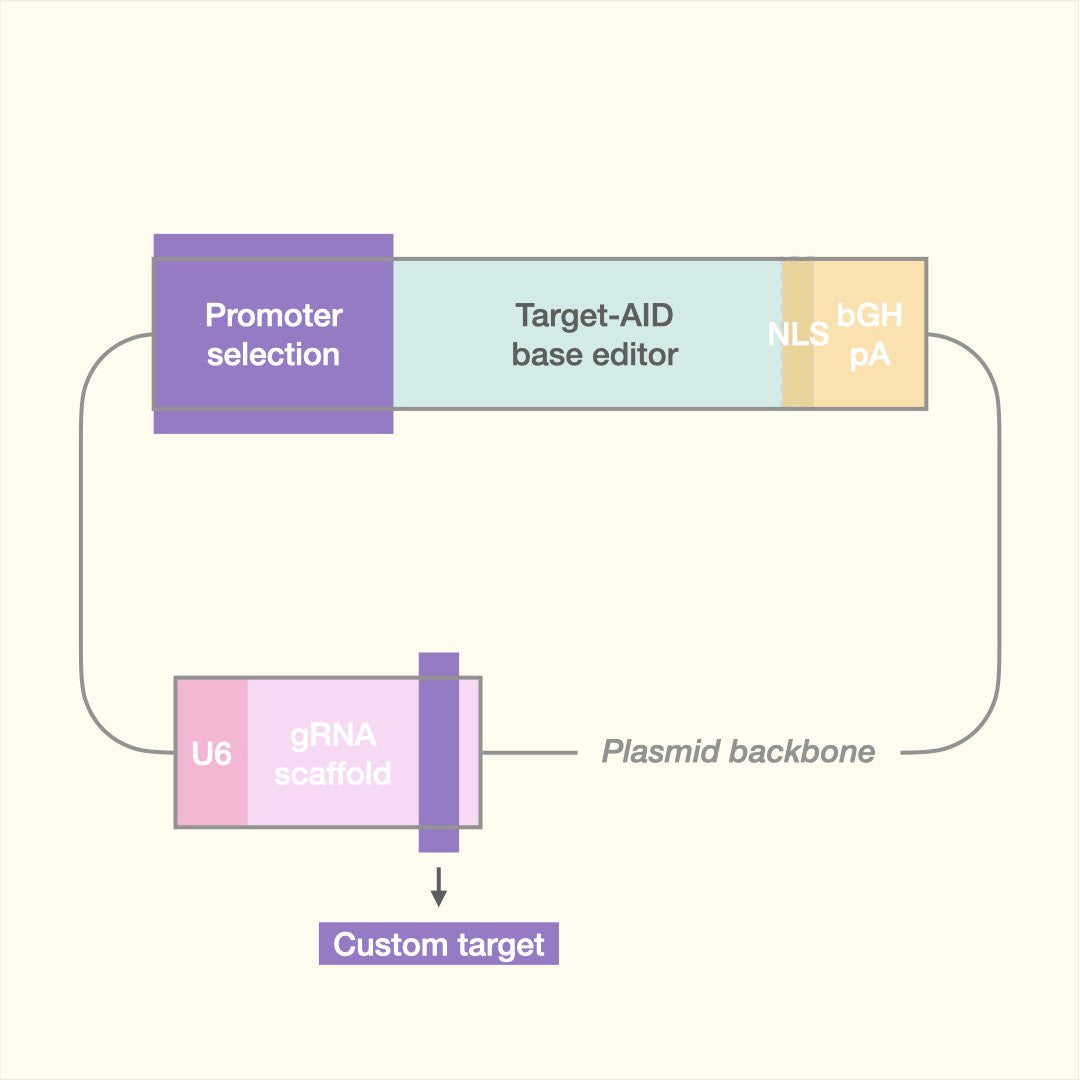
- Target-AID Base Editor: Alternative cytosine base editor using sea lamprey cytidine deaminase. Narrower editing window (positions 2-4) with reduced cellular toxicity.
- bGH PolyA Signal: Compact (225 bp) polyadenylation signal from bovine growth hormone with 3-fold higher expression than SV40 early polyA in key mammalian cell types. Size advantage over SV40 polyA makes it the preferred terminator for AAV vectors with limited cargo space. Standard terminator in commercial gene therapy and lentiviral vector platforms with decades of in vivo validation.
- U6 Promoter: RNA polymerase III promoter that drives constitutive expression of small RNAs. Provides strong, stable transcription with precise transcriptional start and termination sites.
Specifications
High-copy plasmid DNA produced in E. coli with pMB1 origin of replication and ampicillin resistance marker. Purified by endotoxin-reduced anion-exchange chromatography (PureLink Maxi) and resuspended in TE buffer (10 mM Tris-HCl, 1 mM EDTA, pH 8.0). Purity confirmed by A260/A280 spectrophotometry (≥1.8). Identity confirmed by Sanger or long-read sequencing. Yield ≥500 µg. Store at −20°C. Avoid repeated freeze-thaw cycles.
Deliverables
- Plasmid DNA at ≥500 µg, endotoxin-reduced maxiprep
- Payload sequence file
- QC report (A260/A280 ratio, concentration, restriction digest or sequencing confirmation)
- Ships on dry ice
References
Share