Custom Cytosine Base Editor (AAV)
Custom Cytosine Base Editor (AAV)
SKU:
Couldn't load pickup availability
Precision C-to-T base editing via dual-AAV split-intein delivery for in vivo applications. SpCas9-based CBE systems reconstitute in target cells from co-transduced N-terminal and C-terminal AAV vectors. Ideal for liver, muscle, and CNS applications requiring C-to-T editing with established SpCas9 PAM compatibility and editing windows. Choose BE3 for foundational validation or BE4max for enhanced efficiency and reduced indels.
Payload
- BE3: Third-generation cytosine base editor that converts C·G base pairs to T·A within a window of about five nucleotides at the PAM-distal end of the protospacer, without creating double-strand breaks. It fuses rat APOBEC1 cytidine deaminase to Cas9 D10A nickase and uracil glycosylase inhibitor (UGI) through an XTEN linker.
- bGH PolyA Signal: Compact (225 bp) polyadenylation signal from bovine growth hormone with 3-fold higher expression than SV40 early polyA in key mammalian cell types. Size advantage over SV40 polyA makes it the preferred terminator for AAV vectors with limited cargo space. Standard terminator in commercial gene therapy and lentiviral vector platforms with decades of in vivo validation.
- U6 Promoter: RNA polymerase III promoter that drives constitutive expression of small RNAs. Provides strong, stable transcription with precise transcriptional start and termination sites.
- U6 Promoter: RNA polymerase III promoter that drives constitutive expression of small RNAs. Provides strong, stable transcription with precise transcriptional start and termination sites.
- BE4max Base Editor: Optimized cytosine base editor with 1.8× higher efficiency than BE4. Enhanced nuclear import and codon optimization boost C-to-T conversion.
- bGH PolyA Signal: Compact (225 bp) polyadenylation signal from bovine growth hormone with 3-fold higher expression than SV40 early polyA in key mammalian cell types. Size advantage over SV40 polyA makes it the preferred terminator for AAV vectors with limited cargo space. Standard terminator in commercial gene therapy and lentiviral vector platforms with decades of in vivo validation.
- AncBE4max Base Editor: Advanced CBE using ancestral APOBEC reconstruction. Minimized transcriptome-wide off-targets with narrower editing window and lower toxicity.
- bGH PolyA Signal: Compact (225 bp) polyadenylation signal from bovine growth hormone with 3-fold higher expression than SV40 early polyA in key mammalian cell types. Size advantage over SV40 polyA makes it the preferred terminator for AAV vectors with limited cargo space. Standard terminator in commercial gene therapy and lentiviral vector platforms with decades of in vivo validation.
- U6 Promoter: RNA polymerase III promoter that drives constitutive expression of small RNAs. Provides strong, stable transcription with precise transcriptional start and termination sites.
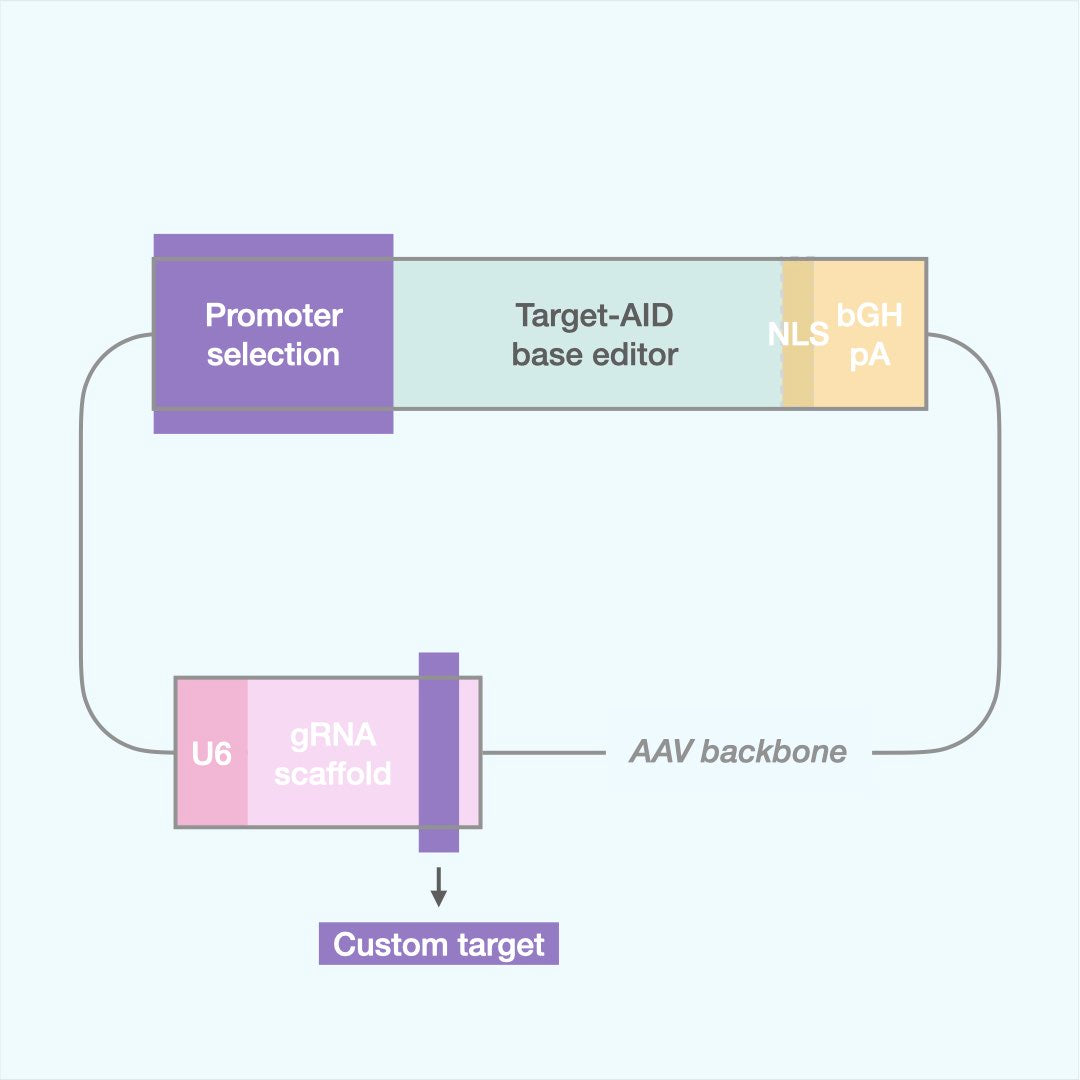
- Target-AID Base Editor: Alternative cytosine base editor using sea lamprey cytidine deaminase. Narrower editing window (positions 2-4) with reduced cellular toxicity.
- bGH PolyA Signal: Compact (225 bp) polyadenylation signal from bovine growth hormone with 3-fold higher expression than SV40 early polyA in key mammalian cell types. Size advantage over SV40 polyA makes it the preferred terminator for AAV vectors with limited cargo space. Standard terminator in commercial gene therapy and lentiviral vector platforms with decades of in vivo validation.
- U6 Promoter: RNA polymerase III promoter that drives constitutive expression of small RNAs. Provides strong, stable transcription with precise transcriptional start and termination sites.
Specifications
Single-stranded AAV produced in HEK293T cells via triple transfection and purified by two rounds of CsCl ultracentrifugation. Titer determined by qPCR. Full capsid content ≥85% by mass photometry. Endotoxin ≤1 EU per 1×10¹³ VG. Purity ≥95% by SDS-PAGE. Formulated in DPBS supplemented with 150 mM NaCl and 0.001% Pluronic F-68. Store at −80°C long-term. Stable at −20°C for up to 2 months and at 4°C for 1–2 weeks after thaw.
Deliverables
- Purified AAV at 1e13 VG/mL or higher in selected volume
- Full capsid ratio 0.85 or higher
- Batch report (titer, full/empty ratio, endotoxin, SDS-PAGE)
- Payload sequence file
- Ships on dry ice
References
Share