AAV Pulmonary Capsid Panel
AAV Pulmonary Capsid Panel
SKU:
Couldn't load pickup availability
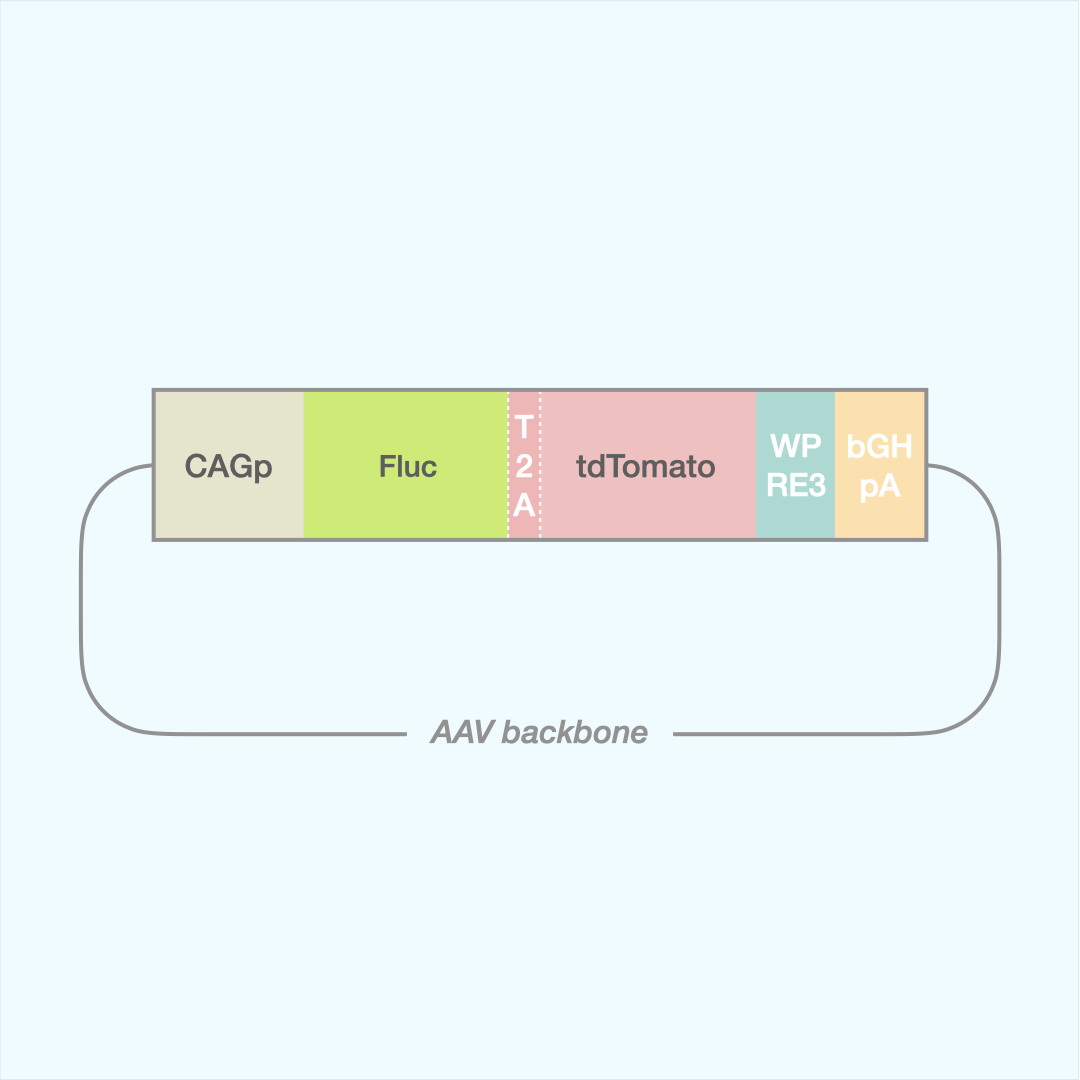
Curated screening panel including tyrosine-mutant, airway-selected, and natively airway-tropic AAV capsids for pulmonary gene delivery and respiratory research. Available with dual fluorescent/bioluminescent reporter cassettes for microscopy, flow cytometry, and in vivo bioluminescence imaging from a single vector.
Core Panel includes AAV2 (standard), AAV5 (apical airway epithelium tropism), AAV6.2 (enhanced airway transduction over AAV6), AAV6.2FF (dual tyrosine mutant, best-in-class airway efficiency), AAV2H22 (lung-selected), AAV2-5T (lung-tropic hybrid)
Expanded Panel adds AAV1, AAV6, AAV7, AAV8, AAV9, AAV-DJ, Anc80, AAV9-F, and AAV-Hu-37 for broader tropism coverage.
Payload
- CAG Promoter: Synthetic hybrid promoter composed of the CMV immediate-early enhancer and chicken β-actin promoter, enabling strong, ubiquitous expression across most mammalian cell types. Produces very high initial expression but may undergo silencing in certain tissues over long-term in vivo studies.
- T2A Self-Cleaving Peptide: Self-cleaving 2A peptide from Thosea asigna virus, the second most efficient of the four viral 2A peptides. Enables stoichiometric co-expression of two proteins from a single open reading frame without IRES elements or separate promoters. Widely used in multi-gene constructs and reporter systems.
- bGH PolyA Signal: Compact (225 bp) polyadenylation signal from bovine growth hormone with 3-fold higher expression than SV40 early polyA in key mammalian cell types. Size advantage over SV40 polyA makes it the preferred terminator for AAV vectors with limited cargo space. Standard terminator in commercial gene therapy and lentiviral vector platforms with decades of in vivo validation.
- CAG Promoter: Synthetic hybrid promoter composed of the CMV immediate-early enhancer and chicken β-actin promoter, enabling strong, ubiquitous expression across most mammalian cell types. Produces very high initial expression but may undergo silencing in certain tissues over long-term in vivo studies.
- T2A Self-Cleaving Peptide: Self-cleaving 2A peptide from Thosea asigna virus, the second most efficient of the four viral 2A peptides. Enables stoichiometric co-expression of two proteins from a single open reading frame without IRES elements or separate promoters. Widely used in multi-gene constructs and reporter systems.
- tdTomato: Brightest commonly used red fluorescent protein (554/581 nm) formed by tandem fusion of two dTomato units, yielding ~4-fold greater brightness than mCherry with excellent photostability. Ideal for applications requiring maximum signal, though the 105 kDa tandem dimer structure is incompatible with fusion tags on proteins sensitive to oligomerization.
- bGH PolyA Signal: Compact (225 bp) polyadenylation signal from bovine growth hormone with 3-fold higher expression than SV40 early polyA in key mammalian cell types. Size advantage over SV40 polyA makes it the preferred terminator for AAV vectors with limited cargo space. Standard terminator in commercial gene therapy and lentiviral vector platforms with decades of in vivo validation.
Specifications
Single-stranded AAV produced in HEK293T cells via triple transfection and purified by two rounds of CsCl ultracentrifugation. Titer determined by qPCR. Full capsid content ≥85% by mass photometry. Endotoxin ≤1 EU per 1×10¹³ VG. Purity ≥95% by SDS-PAGE. Formulated in DPBS supplemented with 150 mM NaCl and 0.001% Pluronic F-68. Store at −80°C long-term. Stable at −20°C for up to 2 months and at 4°C for 1–2 weeks after thaw.
Deliverables
- Purified AAV at 1e13 VG/mL or higher, 0.1 mL per capsid
- Full capsid ratio 0.85 or higher
- Batch report (titer, full/empty ratio, endotoxin, SDS-PAGE)
- Payload sequence file
- Ships on dry ice
References
Share