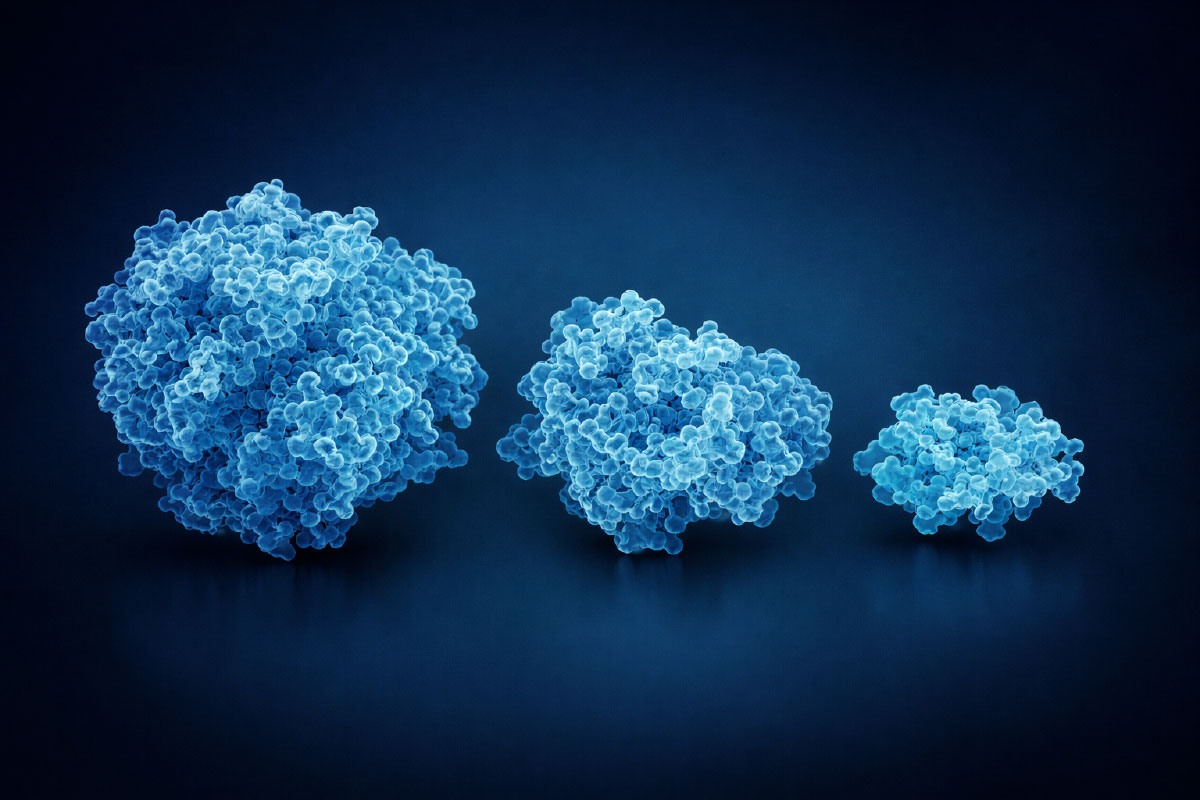
Delivery, not chemistry, is the fundamental constraint confronted by in vivo genome editing today. While CRISPR systems for precise editing are fast developing and diversifying, their therapeutic potential hinges on packaging the complex molecular machinary into vehicles small and potent enough to reach and alter target tissues. The long-term clinical translation bottleneck isn't what can be edited, but what can be efficiently packaged and delivered.
The AAV Packaging Limit and Its Consequences
Adeno-associated virus (AAV) vectors remain the primary delivery platform for in vivo gene therapy. Their safety profile, broad tissue tropism, and ability to transduce both dividing and non-dividing cells make them clinically indispensable. However, AAV imposes strict cargo constraints of approximately 4.7 kb between inverted terminal repeats. This is all the available real-estate to accomodate the nuclease coding sequence, promoter and regulatory elements, a guide RNA expression cassette, and potentially other necessary components.
SpCas9 from Streptococcus pyogenes, the most widely studied CRISPR nuclease, encodes 1,368 amino acids (~4.1 kb). When paired with regulatory elements and guide RNA, a complete system exceeds 5.2 kb. The choices are splitting the payload across two AAV vectors or switching to drastically smaller, commonly referred to as compact, CRISPR-associated nucleases.
Split-vector approaches carry quantifiable penalties. The requirement for both vectors to transduce the same cell for functional reconstitution reduces effective editing efficiency by the square of individual transduction rates. Manufacturing complexity also doubles and regulatory pathways become more complex. For systemic delivery, increased viral load raises immunogenicity concerns. While dual-AAV systems can serve niche modalities where the benefits outweigh the risks, they are not an option for most gene therapy programs.
SaCas9: The First Size-Driven Compromise
In 2015, Ran et al. addressed this constraint by characterizing Staphylococcus aureus Cas9 (SaCas9), a 1,053 amino acid ortholog (~3.2 kb). The 1 kb reduction in nuclease size enabled single-AAV packaging with a complete editing system. When targeting the cholesterol regulatory gene Pcsk9 in mouse liver, SaCas9 achieved greater than 40% indel frequency within one week, accompanied by measurable reductions in serum PCSK9 and total cholesterol.
SaCas9 represented proof of concept that smaller Cas proteins could enable in vivo editing while maintaining functional efficacy. However, this came with trade-offs. SaCas9 recognizes an NNGRRT protospacer adjacent motif (PAM), substantially more restrictive than SpCas9's NGG requirement, significantly limiting targetable genomic sites. Additionally, while SaCas9 editing efficiency approached SpCas9 at tested loci, the reduced targeting flexibility proved a practical limitation for therapeutic development targeting specific disease-causing mutations.
Cas12f and the Structural Size Inflection Point
The Cas12f family marked a structural shift in nuclease design. Unlike incremental size reductions achieved through ortholog screening, Cas12f proteins represent a fundamentally different molecular architecture. Un1Cas12f1 from uncultivated archaea comprises 529 amino acids (~1.6 kb), less than 40% the size of SpCas9.
Wild-type Cas12f showed minimal activity in mammalian cells. Through iterative protein optimization and guide RNA redesign, Xu et al. engineered CasMINI, transforming an inactive archaeal nuclease into a functional mammalian genome editor. The engineered system demonstrated gene activation capabilities comparable to Cas12a while maintaining high specificity with undetectable off-target effects at tested sites.
Subsequent work further improved these compact systems. The hpCasMINI variant, engineered by adding an N-terminal α-helix structure, increased DNA cleavage activity 1.1- to 19.5-fold compared to the original CasMINI across multiple genomic loci. This variant has enabled in vivo applications including liver gene activation and tumor model construction through simultaneous gene disruption and oncogenic allele insertion.
Looking to apply these systems in your own work? We've compiled a collection of AAV-compatible designs with compact CRISPR nucleases on GeneStream. For custom AAV packaging services, visit our custom AAV platform page or reach out at customer@ambryon.com.
Comprehensive assessments revealed that Cas12f nucleases, particularly CasMINI, exhibit higher specificity than Cas9 or Cas12a systems. While editing efficiency was initially lower than conventional nucleases, CasMINI produced fewer off-target cleavage events and structural variations. The staggered DNA cleavage pattern (with cuts occurring 14-16 nucleotides and 24 nucleotides downstream of the PAM on non-targeted and targeted strands, respectively) generates 11 base pair overhangs that appear to suppress large deletions and chromosomal translocations.
Mammalian validation demonstrated that CasMINI maintains genomic integrity at effectively edited loci. In cases where the enzyme induced DNA modifications efficiently, chromosomal translocation frequencies decreased 2- to 3-fold compared to Cas9 and Cas12a. This safety profile, combined with AAV-compatible size, has positioned Cas12f as a promising editing platform.
Recent Compact Nuclease Developments
The trend toward delivery-constrained design continues accelerating. Mammoth Biosciences has developed NanoCas, an ultracompact system (~400 amino acids) derived from metagenomic screening of 176 candidate CRISPR systems. When delivered via single AAV in non-human primates, NanoCas achieved up to 30% editing efficiency in skeletal muscle targeting the dystrophin gene, with 15% editing in cardiac tissue. In humanized mouse models of Duchenne muscular dystrophy, the system produced 10-40% editing across quadriceps, calf, and heart muscle. Analysis of liver tissue showed minimal off-target activity.
Engineered systems like Synthego's hfCas12Max (1,080 amino acids) demonstrate that rational protein engineering can balance size reduction with enhanced functionality. Derived from Cas12i through directed evolution, hfCas12Max exhibits broad PAM recognition (5'-TN-3' or 5'-TTN-3') while maintaining high fidelity. The system demonstrates efficient editing in primary T cells and induced pluripotent stem cells, with minimal off-target effects compared to other Cas12 variants. Its intermediate size (larger than Cas12f but substantially smaller than Cas9) provides AAV compatibility while expanding targetable genomic space through relaxed PAM requirements.
Implications for System Design
Recent developments establish clear design principles for in vivo editing platforms:
Delivery constraint drives architecture. Nuclease size to a large extent dictates which therapeutic strategies are technically feasible. Single-AAV delivery simplifies manufacturing, reduces immunogenic burden, and improves transduction efficiency compared to dual-vector systems.
Compactness enables payload flexibility. Smaller nucleases create space for tissue-specific promoters, optimized regulatory elements, and multiple guide RNAs. A 400 amino acid nuclease (~1.2 kb) leaves over 3 kb for additional genetic components within AAV packaging limits. This headroom is essential for applications requiring complex editing logic.
Efficiency-specificity trade-offs require case-by-case evaluation. Compact nucleases initially showed reduced on-target activity compared to SpCas9. However, systems like hpCasMINI and hfCas12Max now approach conventional nuclease efficiency while maintaining superior specificity profiles. For therapeutic applications where safety margins are critical, a modest reduction in editing efficiency may be acceptable if off-target events and chromosomal aberrations decrease substantially.
PAM flexibility remains a critical parameter. Smaller nucleases cannot compensate for restrictive PAM requirements that exclude therapeutic targets. Systems like hfCas12Max with broad PAM recognition (TN or TTN) enable targeting of AT-rich genomic regions while maintaining compact size. This balance is particularly relevant for treating genetic diseases where pathogenic variants occur at specific nucleotide positions with limited PAM availability.
Validation requirements intensify with size reduction. Compact nucleases derived from archaeal or metagenomic sources often require extensive engineering for mammalian cell function. CasMINI needed both protein engineering and guide RNA optimization. NanoCas emerged from screening 176 candidates followed by additional refinement. Therapeutic development demands rigorous validation of on-target efficiency, specificity, and in vivo performance in disease-relevant models.
Future systems will likely prioritize delivery compatibility from the outset, treating AAV packaging limits as design specifications. For in vivo genome editing to fulfill its clinical potential, nuclease engineering must continue this trajectory: smaller, more efficient, more specific.